
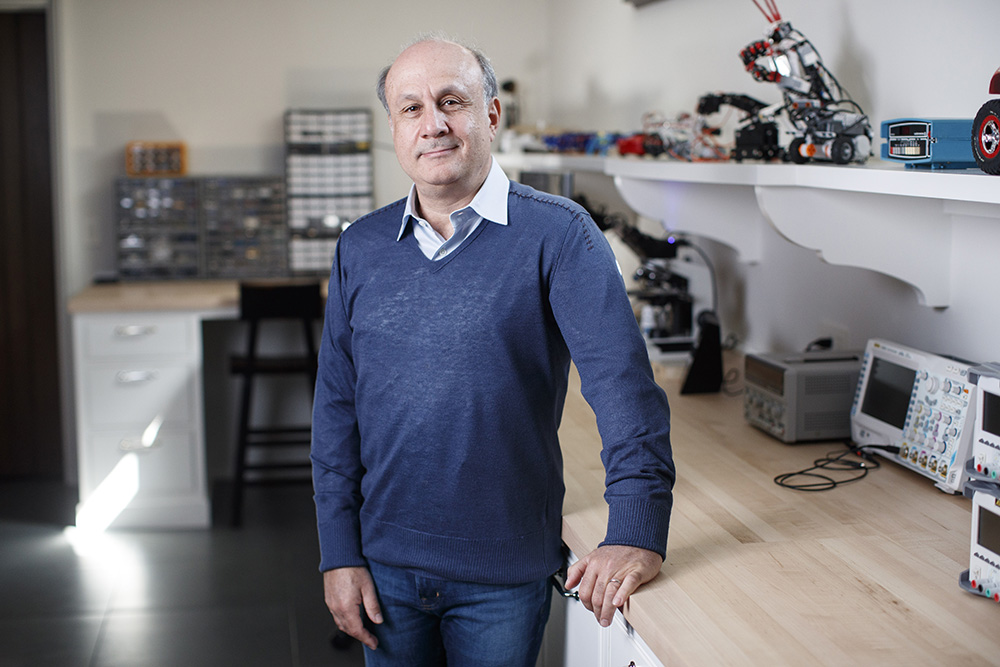

David Siegel SM ’86, PhD ’91, a computer scientist, entrepreneur, and philanthropist, will serve as the next MIT Innovation Fellow during the 2026-27 academic year. Working with the MIT Schwarzman College of Computing, Siegel will explore how artificial intelligence can accelerate scientific discovery at the Institute and beyond.
“From the MIT Schwarzman College of Computing to the MIT Siegel Family Quest for Intelligence, David has been a superb thought partner for me and other Institute leaders on a range of very significant initiatives, so we’re delighted to have him join us now as an MIT Innovation Fellow,” says MIT President Sally Kornbluth. “Our community has long benefited from David’s exceptional technical insight, entrepreneurial experience, instinct for connecting people, and infectious love for MIT. We look forward to working with him now as he helps us identify new opportunities at the intersection of AI and scientific discovery.”
“MIT has played a foundational role in shaping how I view technology’s potential to address complex challenges,” says Siegel. “I’m thrilled to return to campus as an Innovation Fellow to collaborate with brilliant students, researchers, and faculty at a pivotal juncture in how technology shapes our world.”
A long-standing connection to MIT
Siegel’s relationship with MIT began during his graduate studies, where he earned a master’s degree in 1986 and PhD in 1991, after earning his bachelor’s degree in electrical engineering and computer science from Princeton University in 1983. Immersed in the field during a foundational era for computer science, he worked at the MIT Artificial Intelligence Lab (now the Computer Science and Artificial Intelligence Laboratory) in Professor Tomás Lozano-Pérez’s research group on human-machine interaction, contributing to the development of a pioneering humanlike robotic hand.
Siegel has remained deeply involved with the Institute in the years since. He is a life member of the MIT Corporation, previously served on its Executive Committee, and co-chairs the External Advisory Committee for the MIT Schwarzman College of Computing. Additionally, Siegel was an early champion of the MIT Quest for Intelligence, an Institute-wide initiative studying intelligence in brains and machines, recently renamed the MIT Siegel Family Quest for Intelligence.
Entrepreneurship, philanthropy, and AI leadership
After completing his PhD, Siegel founded several early internet ventures before co-founding Two Sigma in 2001. A leading global investment firm, Two Sigma approaches investing through a data science and engineering lens, echoing Siegel’s experience in the MIT AI Lab. With the scientific method embedded in its culture, the firm uses artificial intelligence, machine learning, and advanced quantitative modeling. Siegel retired from day-to-day management of Two Sigma in 2024; however, he remains co-chair.
Currently, Siegel’s work spans several fields, with a strong emphasis on science, technology, and philanthropy. Through the Siegel Family Endowment, a philanthropic foundation that he established in 2011, Siegel supports leaders, researchers, and organizations that are examining how technological change affects society and how to guide that shift for the public good. The endowment backs organizations such as the Scratch Foundation, Center on Rural Innovation, Khan Academy, Pursuit, and The Aspen Institute.
Recognizing the critical resource gap between academic research labs and frontier AI, Siegel founded the nonprofit Open Athena in 2024. Open Athena equips academic research labs with elite AI talent, data engineering expertise, and computational resources to enable groundbreaking discoveries at scale. The organization is also developing Marin, a 535-billion-parameter foundation model built entirely in public. By sharing every dataset and experiment in real-time, Marin ensures that the science of frontier AI remains a shared public asset for researchers and innovators worldwide. Open Athena works with leading global institutions including MIT and is funded by philanthropic partners including Bloomberg Philanthropies, Google, The Huang Foundation, and Schmidt Sciences.
Siegel actively serves on several governance and advisory boards. He is vice-chair of the Scratch Foundation, which he co-founded in 2013 with MIT Professor Mitch Resnick, a member of the Cornell Tech Council, and a board member of organizations such as Re:Build Manufacturing, Khan Academy, and NYC FIRST Robotics. In 2025, Siegel was appointed to the U.S. Department of Energy’s Office of Science Advisory Committee, providing counsel on complex scientific and technical issues impacting federal scientific research programs.
Outside of philanthropy, Siegel remains actively engaged in the global AI ecosystem as an investor, hands-on advisor, and thought leader. Through his family office Shinrai Management, he focuses on supporting entrepreneurs and investing in high-growth startups, including several founded by MIT students and alumni.
Siegel’s debut book, “When Machines Act: The Promise and Peril of Navigating Our Agentic AI Future,” co-authored with Yale University’s Jeffrey Sonnenfeld and Stephen Henriques, will be published by MIT Press next March, coinciding with his residency as an MIT Innovation Fellow. Drawing on interviews with top tech leaders and off-the-record discussions with over 300 CEOs, the book provides a practical roadmap for autonomous AI, outlining where to deploy it, how to govern it, and which rules truly matter.
“David’s ties to MIT date back to his doctoral research in the AI Lab and have deepened through his many contributions to the Institute, including his significant involvement with the Quest for Intelligence and the MIT Schwarzman College of Computing,” says MIT Provost Anantha Chandrakasan. “His long-standing commitment to MIT, together with his vision for the future of AI and science, makes him an especially fitting Innovation Fellow. We look forward to the contributions he will make and the connections his work will foster across campus.”
“For the MIT Schwarzman College of Computing, David’s fellowship is a chance to build on an already strong connection and explore how AI can expand the frontiers of science. Having known David since we were both graduate students at MIT, I’m deeply familiar with his ability to advance AI and its application in various fields,” says Dan Huttenlocher, dean of the MIT Schwarzman College of Computing and the Panasonic Professor of Electrical Engineering and Computer Science. “He understands both the college’s aspirations and the challenges ahead, and his perspective will help us identify concrete paths for research, education, and broader engagement. I look forward to working with him over the coming year.”
A year in residence
MIT Innovation Fellows typically spend a year or more in residence at the Institute. They draw on their experience, expertise, and professional networks to engage with faculty and students, participate in public events, and provide strategic counsel to MIT leaders.
The program has brought luminaries from industry and government to MIT. Most recently, Brian Deese, former White House National Economic Council director, served as an Innovation Fellow. Other fellows have included Virginia M. “Ginny” Rometty, former chair, president, and CEO of IBM; Eric Schmidt, former executive chair of Google’s parent company, Alphabet; the late Ash Carter, former U.S. secretary of defense; and former Massachusetts Governor Deval Patrick.
As an Innovation Fellow, Siegel will help guide the Institute’s focus on leveraging artificial intelligence to support scientific discovery, working closely with the MIT Schwarzman College of Computing and departments across the college to help extend their impact beyond MIT.
“Using AI to accelerate scientific discovery is the ultimate engineering challenge. There is simply no better launchpad in the world for that work than MIT,” says Siegel.